
Compliance
AODocs Solution Supports Financial Services Compliance with Google Workspace

Solution Consultant - Presales, AODocs · Jun 30, 2025 · Updated Oct 6, 2026
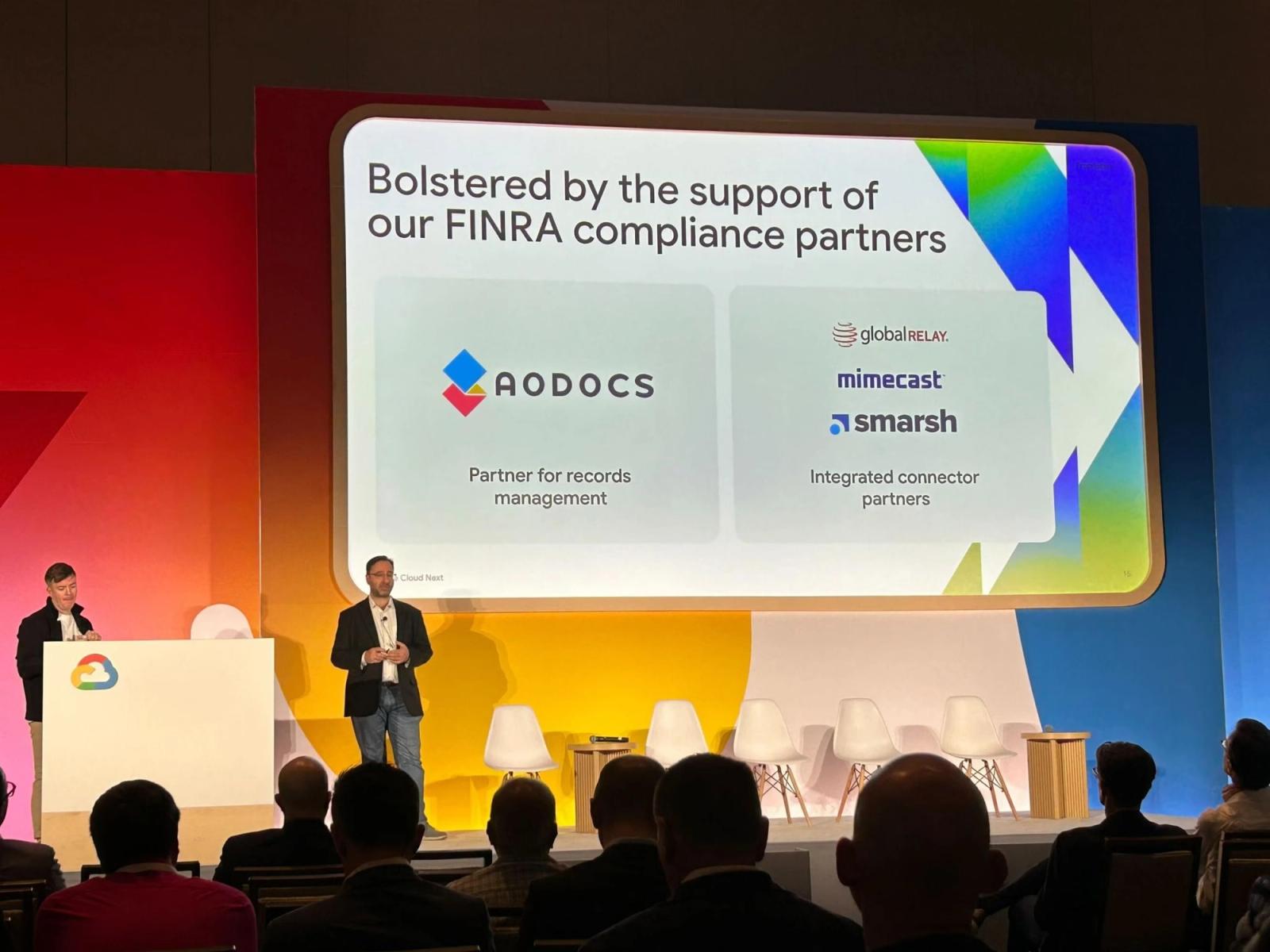
Staying compliant with SEC and FINRA retention rules and regulations has long been a challenge for financial services firms striving to move fast without sacrificing control. Our partnership with Google Workspace provides an out-of-the-box records management solution—AODocs Compliance Archive, that enables seamless collaboration with built-in regulatory compliance features for broker/dealer electronic records.
Financial services organizations operate in a high-stakes regulatory environment where efficiency and control must go hand in hand. Navigating compliance, particularly with the Securities and Exchange Commission (SEC) and Financial Industry Regulatory Authority (FINRA), can be both complex and resource-intensive. Now, there’s some welcome news for firms looking to achieve both real-time collaboration and resilient retention of financial and banking records.
That’s why we’ve partnered with Google Workspace to deliver an out-of-the-box records management solution built for tightly regulated industries.
AODocs Compliance Archive combines Google Drive collaboration with configured retention and audit controls, supporting financial institutions' document processes and compliance programs.
Why This Matters
At its core, this new solution addresses a longstanding pain point in financial services: how to stay compliant with rigorous regulations while maintaining business agility.
- Google Workspace offers fast, flexible collaboration for teams across the organization.
- AODocs Compliance Archive adds a secure framework for document retention and archiving that aligns with SEC and FINRA rules.
For firms managing securities-related communications, trade confirmations, customer records, or internal oversight documentation, AODocs Compliance Archive solution built on top of Google Workspace provides a path to enforce policy-based controls, without slowing down day-to-day operations.
The Regulatory Retention Rules Landscape: Complex, Costly, and Critical
FINRA is a self-regulatory organization overseeing member broker-dealer firms and their associated individuals. While not a government agency, FINRA works with the SEC to protect investors and maintain market integrity.
Compliance with FINRA's rules is required for its member firms. Member firms must assess the rules applicable to their activities and records.
Failure to comply can trigger business suspension or regulatory scrutiny. Even a seemingly administrative oversight can result in operational disruptions or penalties.
This challenge becomes even more complex as firms must also comply with SEC Rule 17a-4, which sets preservation, accessibility, and production requirements for covered broker-dealer records. Electronic recordkeeping systems may use non-rewriteable, non-erasable WORM storage or the rule's audit-trail alternative, which must permit recreation of original records after modification or deletion. Applicable retention periods and other safeguards still need to be met.
Assess the configured system, record types, access, retrieval, and required undertakings against the rule before relying on an archive.
Either companies build an in-house compliance operation, which is expensive, rigid, and prone to human error. Or they can rely on manual oversight. But this approach carries risks and is increasingly unsustainable in today’s fast-paced, digital-first environment.
Why New Generation Document Management Matters
On the face of it, Legacy Document Management Systems (DMS) could have been the go-to solution for financial institutions’ compliance needs. But they were not built for the cloud era, or for the modern financial regulatory landscape. Today’s firms need a third-generation solution that is:
- Integrated: Built into platforms employees already use, like Google Workspace.
- Compliance support: Designed to align with SEC rules for retention, access, and auditability.
- Efficient: Flexible enough to scale across teams without adding administrative burden.
That’s where the AODocs + Google Workspace solution fits in.
Built for Financial Services Teams
If your organization uses Google Workspace, evaluate how AODocs archive controls fit its recordkeeping program. Confirm configuration, operating procedures, training, and responsibilities before deployment.
Whether you’re archiving investor communications or enforcing retention policies for sensitive banking records, the platform enables you to:
- Apply document controls directly in Google Drive.
- Automate retention and audit policies.
- Support applicable SEC and FINRA recordkeeping requirements, subject to configuration and firm procedures.
- Manage compliance risks through tested controls and assigned operating responsibilities.
A Practical Step Toward Smarter Compliance
In summation, the AODocs solution built on top of Google Workspace offers a much-needed win-win for financial firms: a way to support compliant recordkeeping and collaboration. For CIOs, compliance officers, and business leaders in finance, it’s an opportunity to rethink how technology can serve both operational agility and regulatory rigor.
Learn more
- Workspace FINRA compliance updates, please visit the blog here.
- How this solution supports your SEC and FINRA compliance strategy, see our Record Management and Retention or Banking and Insurance page.
Frequently asked questions
Does using Google Workspace make a financial services firm FINRA compliant?
No. Google Workspace can support a recordkeeping program, but the firm remains responsible for identifying regulated records, setting applicable retention periods, supervising use, and checking access and retrieval. Google describes records-management capabilities for Drive; deployment still needs to be assessed against the firm's SEC and FINRA obligations.
Does SEC Rule 17a-4 require WORM storage for every electronic record?
No. For broker-dealers using electronic recordkeeping systems, SEC Rule 17a-4 permits either the WORM approach or an audit-trail alternative meeting the rule. The alternative must allow an original record to be recreated if it is modified or deleted. Ordinary file versioning alone does not establish that these requirements have been met.
What should a broker-dealer check before archiving Google Drive records?
A broker-dealer should map the record types and retention rules, test preservation and regulator retrieval, and document who can administer or access the archive. It should also review the relevant undertakings and recovery arrangements under Rule 17a-4. These checks assess the deployed recordkeeping process, rather than treating the collaboration tool as a compliance guarantee.
Can a retention policy cover every financial record for the same number of years?
A single retention period may be inappropriate because requirements vary by record type and applicable rule. FINRA Rule 4511 provides a six-year minimum only for FINRA books and records without another specified period under FINRA or Exchange Act rules. Build the schedule from the actual obligations and have the responsible compliance team review it.


